📚Homeschool history, tip #5 (a series)📚
Historical orientation: know this term.
If you’re studying the past, and you’re raising kids to study the past, historical orientation should be at the forefront of your mind and a natural part of your daily life.
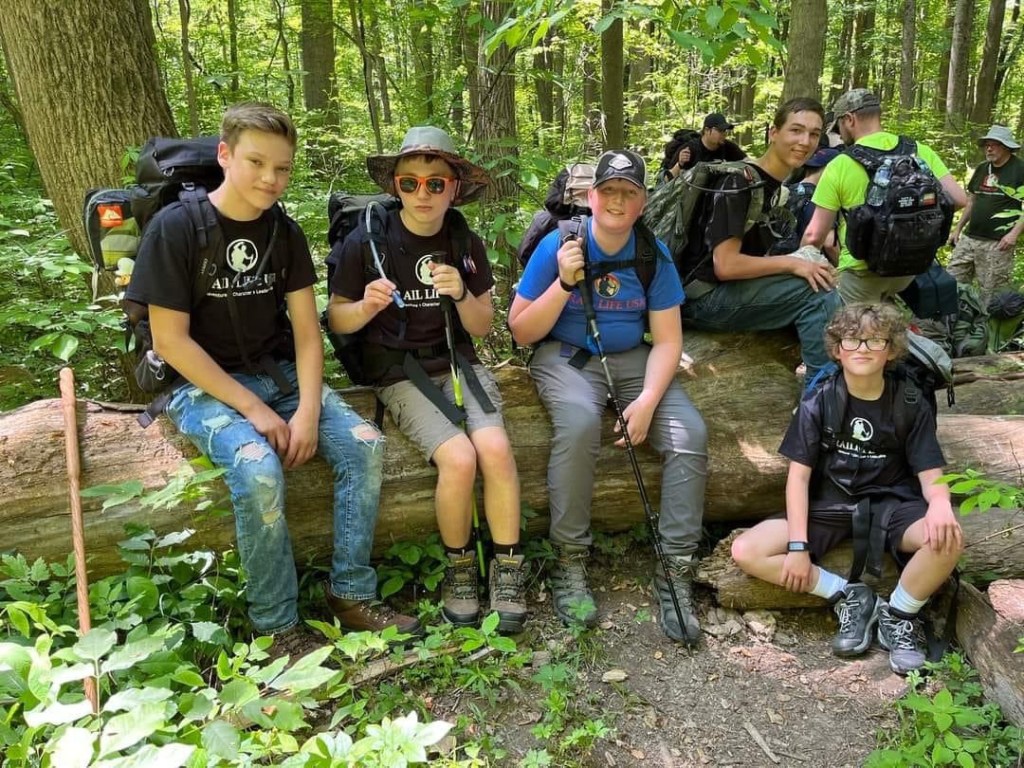
My son (left) is a part of Trail Life USA. It’s an excellent program, and he gets to do the coolest things with his friends, his troop, his dad, and his grandfather (the Commander of the troop). (I highly recommend this program!) This weekend they all braved the heat, humidity, and bugs, to hike and camp in a pretty remote area.
My guys came home absolutely exhausted: my son, having carried a super heavy backpack and sweating buckets for 24 hours threw himself on my bed and said, “It was AWESOME. Best time EVER.” I’m thrilled that he gets this opportunity and that he’s growing, maturing, and gaining wisdom along with some of his best friends. I made a mental note that it was a successful weekend, and moved on with my day.
After a few hours (and some much-needed showers), our son came to me and said, “Hey mom, do you want to see a video I made?” He had taken various clips and made a 25 minute compilation video of his weekend, his friends, and his experiences. {Here’s the interesting part for me as a historian.} He decided, before filming, that he was going to show this compilation to his friends 25 years later. He asked them to give their future selves a message, and they would all watch it when they were adults. The guys all delivered their messages and he was able to get all kinds of memorable experiences on film—and then edited it in an app.
Now, this post isn’t about how great my son is (although I think he’s the greatest boy in the world). What strikes me as important about this is that my almost-13 year old had the foresight to (1) value the experiences with his troop enough to record it for posterity, and (2) record specific responses from his friends with the sole purpose of watching them YEARS in the future. This isn’t about a kid with a camera: for me, it’s the product of years of careful and intentional historical orientation. For me, this initiative was confirmation that my method of historical education is working.
What IS historical orientation?
It’s the careful, deliberate orienting of children to things of the past. Some key points regarding the importance of historical orientation include:
-The understanding that we are ON and IN the timeline of human history: it’s not “the past” vs the present, or “now” and “back then”, but rather that we are a part of the continuation of time. This shift in perspective is really important in terms of how we understand chronology, and how we make connections between past events.
-As participants in human history, our stories matter. Their stories matter. Documenting the present and preserving the past are ABSOLUTELY ESSENTIAL for posterity and the historical record. Protecting our experiences through documentation shows that we care about future people and the efforts of future historians. In my opinion, caring about posterity is a sign of selflessness—-and I aim to see that quality in my children as a parent, homeschooler, and historian. We all should.
-Historical orientation makes the past an important part of the present by bringing it into daily life: historical sites, re-enactments, museums, old towns, old buildings, interviews with older family members, historical movies and TV shows, historical fiction/non-fiction, and fostering an interest in heritage are all ways to orient us to the study and appreciation of history.
What this looks like in practicality is different for everyone, so I can only speak to my own parenting.
Here are some ways I’ve oriented our kids to the past:
- We go to every re-enactment we can find. I don’t make it a “school” thing or require an essay afterwards (please don’t do that). I let them wander without an agenda to get an immersive experience and stimulate personal interest. What bores one kid, excites another.
- I point out old homes, buildings, and features wherever we go:
-“Hey! Do you guys see that iron post outside of that house? That was where people would tie their horses outside before the car was invented.” - I try to relate things we see/experience to a point in the past. (Not all the time, because I could talk FOREVER 😂 But when I feel the time is appropriate.)
-“Whoa, that car looks like it was made around the 1920s! Do you guys remember what kinds of things were happening during that time period?” I’m always surprised that they can recall things like Prohibition, suffrage, organized crime (the Mafia), and the decade before the Great Depression, etc. - Historical orientation affirms the somewhat lofty and humbling concept that people existed before us, and they will exist after us. This helps ground us to the reality that we share the earth with previous and future generations, all of whom make an impact on this big, big story we’re in. Talking about our future selves, future grandkids, future great-great grandkids, the state of our country in the future (etc) reenforces that our choices and decisions matter. Nothing just happens. Everything has a consequence.
- Lastly, we discuss issues surrounding worldview. If we’re participants in and on the timeline of human history, and we need to document the present and protect the past, and what we say and do matters for posterity, then we need to discuss subjects that surround perceptions of truth, morality, government, family, religion, etc. If I know, for example, the worldview of someone who lived in Europe in 1450, I’m more likely to be empathic about their choices and actions—-because they make sense for the time period in which they lived. By recognizing worldview as a key component in understanding the people of the past, we can humbly recognize that people of the future may not agree with our current worldview. Cultures change, morality and shared values change, and the lives of people reflect those changes over time. Having those discussions often helps kids navigate historical subjects which are particularly difficult because we don’t believe the same way they did.
For me, his videos were about more than a memory. They represent the hope that he is valuing and documenting the present for the sake of the future.
And that, my friends, is the kind of history education I want for my kids.

 The Homeschool Historian