Something different.
I started writing curriculum because what I wanted for my children didn’t yet exist.
Chronology & Context
I believe generations of Americans have been taught about the past through the lens of social sciences–in the form of social studies–leaving huge gaps in our collective understanding of chronology and historical context. This has led to high levels of historical illiteracy among the American population. My curriculum specifically targets this problem by introducing every unit chronologically, in its original historical context, and following a certain path specific to American history. It purposefully narrows from world history, to Western Civiliation, to American history so that students understand cause and effect and how they influence the present.
Historical Empathy
My material–both in curriculum and on social media–encourages the development of historical empathy: the ability to understand the world of the past, the people who lived there, and to grasp why they believed, acted, worshipped, worked, and thought as they did. I encourage hands-on historical immersion such as living history museums, reenactments, visiting historical sites and buildings, and reading historical narratives to humanize people of the past in their own historical context.
Critical Thinking
While science classrooms all around the US include an introduction to the scientific method, few history classrooms present the historical method. Students are taught history through separate themes and unit studies in younger grades, then through dry textbooks, memorizing facts and dates which are promptly forgotten after the test. Helping students think critically about the information they’re reading, and introducing them to a wide variety of historical content through various mediums (videos, articles, etc.) empowers them to identify biases in history material. By including many different quality sources in my curriculum, I aim to help students seperate historical fact from historical interpretation.
How It Works
Each curriculum has an introduction page which describes the purpose of the document, the content, and suggestions for use. It will define the suggested ages for the curriculum, and offer helpful hints on how to make the best use of the material.
Chronos, however, is a little different.
Chronos is meant to be used as a spine for every student, every year. It begins with world history, narrows to Western Civilization, and narrows again to American history in order to establish a strong sense of chronology, context, and cause and effect—three elements largely absent from American understanding of the past. It includes 32 lessons intended to be introduced one week at a time: educators can use the curriculum as intended, or adapt it. Each lesson includes terms to know, people to know, places to know, Questions to Ask, primary sources, articles to read, videos to watch, an answer/response section, and various enrichment activities ranging from oral history interviews to craft projects to essays. Select which elements will be useful for your student, and do different ones the following year.
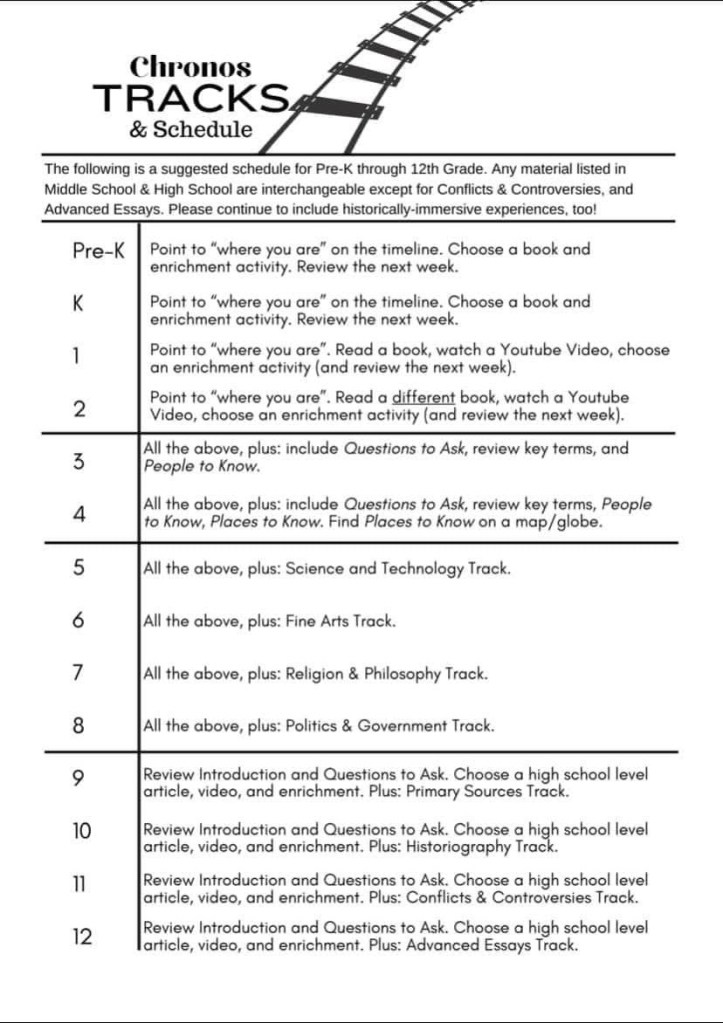
Chronos also has additional options called Chronos:Tracks, which can help educators focus on a particular element within the Chronos model. While not all Tracks are completed, there is currently an Art History Track and a Science & Technology Track (a Religion and Philosophy Track is almost completed). Samples for these are listed in my Teachers Pay Teachers shop.
Below is a suggested schedule for how Chronos and Chronos:Tracks could work in your homeschool or classroom:
Final Thoughts
Chronos, and many of my other documents, are analyzed and updated each year. Sometimes these updates are minor and include changes to sentences for more clarity. Other times, they will include new features and updated enrichment options. They undergo this kind of attention because not only does link rot occur (when links no longer work), but also because I’m constantly reviewing feedback from customers and am driven to provide the best historical resource possible.
And I offer these updates absolutely free of charge.
 The Homeschool Historian